Vernal
After a week, month of turbulent gloom, both literally and metaphorically, I awake early Saturday morning to the sun glowing through the closed blinds and a cat lying on my stomach purring. I’ve reached the stage in life where you sleep with the window open no matter the weather and I lie for a few minutes, hours listening to a robin warbling sweetly in the small strip of lawn between my window and the street. Peace.
I don’t sleep much anymore but it’s felt like a months, years of sleepy winter this time, while I’ve cocooned in my room, often my bed, escaping the world into work, mechanical tasks, formulaic books, soft things, quiet noises. I wasn’t sad or anxious. I wasn’t afraid or depressed. I wasn’t anything at all.
But this Saturday, the pit of my stomach warms. I stir an egg into yogurt in the kitchen, a swirl of maple syrup, a scrape of lemon, while Nina Simone sings Sinnerman and my feet can’t stop moving. I drop each blueberry on one by one, making a pattern like a rising sun, filling it in until it pleases me and then put it in the oven to transform.
I’m half deaf at the moment, my left ear stopped by some unexpected spring cold or the relentlessness of years of headphoned meetings. It’s a strange and disorienting affliction. Noises come from unexpected angles. I don’t know how big a space I fill. I’ve been waiting it for it to clear and the sounds to come rushing back, but I hear only an ever-more insistent buzz. I imagine my ear as an angry punk rock band playing its only song in a neverending crescendo. The irony of this, is that it has been a week about listening hard. I am grateful for two ears.
I don’t sleep much anymore and I miss my dreams. But this Saturday morning, I dream that I want things and those things are elsewhere. I eat my breakfast thinking about boarding a plane to England, driving through fields of Texas bluebonnets, dipping my toes into the ice-cold spring Atlantic, powering a kayak through a salt marsh, skating down a still frozen river while singing Joni Mitchell. Spring is for going places. Spring is for song. I’m half deaf at the moment but I’m getting better. I’m grateful for two years of peace.
But spring is for going places and my feet can’t stop moving toward the rising sun.
At the Roundabout
Three guys, two of whom are named Pete (I’m not sure which two) are talking in front of my stoop and punching each other in the arm. They are carrying lawn chairs and heading to the empty lot two doors down where a house once was. “Hey, how ya doin?” “Good, man, long time no see!”
* * *
Even the platitudes seem joyful as the city wakes from its pandemic slumber. The platitudes are getting us through as we remember what it’s like to have more than one conversation. One morning last week, I got on the bus, not the low rider past the park but the high rise express bus to Manhattan to see my office for the first time since March 11, 2020. I had to plan things out in detail, because I’ve forgotten how to roll out of bed and go. Where was my MetroCard? (newsflash – you don’t even need the MetroCard anymore; I am like Rip Van Winkle opening my eyes to a changed world). What should I wear? Do I remember how to wear shoes? Are my keys still in my work bag?
* * *
A man in with a slight limp and a fast pace charges by the stoop pounding himself in the hip, “I woke up this morning,” he yells to his phone, “and my hip hurt so much I could hardly walk. It was so weird.” He turns past the lot and I can’t see him anymore, but there are two people watching their toddlers rolling on the lawn. In the years since we’ve been here, we only rarely saw people in that lot until the pandemic, when it became a respite for the housebound, a tiny public square.
* * *
I’ve forgotten how to commute. I have to think about every step, remember which is the one of the four buses that comes to my stop that doesn’t go all the way to the office. And then I’m on the bus with a seat to myself staring out the window and I feel like I’m going to cry because it is all so beautifully, wonderfully normal. The sun glints past the Statue of Liberty as the road undulates toward the tunnel and everything goes dark and quiet until suddenly we’re in Manhattan, me for the first time in almost a year, and I watch everything like a tourist.
* * *
I can no longer see the Petes and friend, but I can hear them still talking on the lawn, hidden by Louise’s house. On the other side of the lawn live J&C. J is a folk musician and while we didn’t meet until last fall when he came over and joined in one of our pandemic porch sessions, we’ve since discovered we have a number of friends in common. J is the kind of person who is so joyful about his ideas that people will follow him anywhere – because they want to see what happens, because they don’t want to see him disappointed, because they are looking out for him, I’m not sure. C is his wife, the practical one who pushes the mower around their tiny patch of grass and often walks up and down the block with a claw on a stick, picking up the detritus of a street that gets a regular parade of passers-by. Last weekend, J’s idea was to take a whole bunch of PVC pipes from his basement that he’d sawn off to precise pitches, and stage an aleatoric music event. He emailed 50 friends and neighbors and about half that number showed up at the vacant lot in the steaming heat on a Sunday evening to roll the pipes – some as long as 16 feet – end over end, letting gravity tip them until they landed on the ground with a resonant tone. We walked slowly and silently with our pipes, in a meditative, even trance-like state until a woman screeched her Toyota to a halt in the street and yelled at us, “What you all DOING?” to which we responded honestly, “We have no idea!” But whatever it was, we did it again, and then we stood talking to our friends and neighbors as the fireflies came out and no one even touched the table of juice and cookies they had put out. “Tumbling Tubes doesn’t seem like the right name for it,” says the Punjabi musician who lives at the other end of our block (he plays the harmonium and is building a recording studio in his garage), shaking his head at J’s suggested title for his opus, then pauses before declaring “Gravity Pipes!” and we all nod in agreement.
* * *
I am in a constant state of comparing what I see to what was. There are yellow chains on the bus blocking out the three rows of seats behind the driver that weren’t there before. The masks on every (yes, every) face are new and the bus is emptier than it used to be, but otherwise the familiarity is reassuring. I move to the back but forget to sit on the side by the river, so instead stare at the parks and office buildings in the cityscape along the west side of the FDR. But the Brooklyn and Manhattan bridges are for both sides and it’s been so long since I’ve seen them that I don’t know what to look at first. I wonder if the rooftop skeleton is still there at his picnic table, under the statue of the Blessed Virgin. I wonder if his leg is still missing. I can’t see him from this side and I make a mental note not to make the same mistake twice, although I’m not sure what next time looks like.
* * *
Louise’s nephew and his husband emerge from the house next door, which since her death, they’ve been renovating, and stop to say hello to Mr. Spy, who is attempting to fix our aging car in the street. “How are you doing, Mr. Spy? It doesn’t really feel like the middle of summer does it?” and everyone agrees that it does not, but that we like the cool rainy weather better than the 100-degree heat from earlier than the week. “Enjoy your weekend! Happy Fourth!” “Same to you!”
* * *
We turn off the FDR into the city streets and nearly everyone gets off the bus at the stop by the hospital. I can’t stop staring at the empty storefronts. I make a catalog of the missing in my head, though I can’t remember them all. Madison Square Park is still there, though. Still there. And I’m thinking about how many times I’ve walked through it when I realize I’ve nearly forgotten to push the button to get out.
* * *
The Petes and friend have packed up their chairs and gone back to their cars and I think they are leaving, but then I hear one of them say to another, “You’ve got to stop and smell the flowers.” I don’t know what this means or hear what comes next, but now one says, “I want to acknowledge the original people who lived here, the Native Americans whose land this was. Are you ready?” He grabs a black bag out of his trunk, and shuts the chairs inside it and they go back to the lawn, which is not now owned by Native Americans but by the company that owns the apartment building around the corner, which has saved it as a space for residents. I await the ceremony, but I am disappointed. I hear nothing, see nothing. Perhaps the Petes have pete-ed away.
* * *
Entering my office building is complicated and there are many signs. They had sent out a 30 page PowerPoint to explain what to do. Make sure you’re masked before you enter the revolving door, down the stairs to the lobby and stop twice to wipe your feet on two different mats to wipe your feet. There’s a place to take your temperature that appears to shoot a laser at your forehead from 4 feet away and declare you okay. You need to sign into an iPad with an app with no instruction that is perfectly opaque. Finally past the gauntlet, I turn to enter the way I always have but find it blocked and have to turn back and go through a different aisle. Every time I leave and reenter the building, I will make the same mistake. Ten years of habit is hard to break. But once inside, our office manager and assistant are sitting at a table under a big “Welcome Back” sign. There are tables of water and snacks and swag bags of PPE — an abbreviation I didn’t even know the last time I stood in this spot — and a package wrapped in paper printed off the internet that turns out to be a phone sanitizer. That paper undid me. That they had bothered to print it out and wrap all these packages for the office pioneers…I nearly lost my composure. I’ve known these people for a long time. “I can’t tell you how good it is to see you. How have you been?” “We are so happy you are here!”
* * *
The lawn has emptied out, but people keep walking by. A couple speaking Spanish points at our cat Jaguar, curled up under a bush next to our stoop and walks on. The family of little girls in pastel-colored tunics and headscarves that comes by nearly every day to see Jaguar walks by with purpose and turns the corner, the youngest running out of line to quickly pat Jaguar on the head before somewhere just out of sight her mother calls her name and she runs off. “I’m here!”
* * *
When I get off the elevator, which I stood in alone on my assigned footprints, the floor is empty. I am the only one there. Even a little later there are still only 2-3 amid the dozens of empty desks. It feels post-apocalyptic, but much cleaner. In my office the calendar on my wall reads March 2020. Amazingly, not only is my plant alive, but it has acquired a twin – someone has taken a cutting (or was it me? Did I do this before I left? I think hard but can’t remember) and put it in a vase and it is now nearly the size of the original. My pictures are off the walls and piled on my desk which puzzled me until I remembered that someone was supposed to come and hang them for me on March 12. I lean them on my bookshelves and it looks tidier. There are piles of papers on my desk, but they are papers from my old job, and it hits me that I’m not quite the same person who was last here. I do different things now. My office is a shrine to what I did before. Will I move to a new space? Will I stay home forever? Do I need to give all these things to the person who has filled my spot? Is this space still mine? My phone does not work. My monitor doesn’t turn on. I am not recognized here. Who am I now. Just before I slip into a full-blown existential crisis, someone emails me to say that everyone in the office was going out to lunch and did I want to join? We said we’d meet in the lobby, but they couldn’t wait. They were around the corner from my desk. We all piled in the elevator (strictly violating the 2-person policy outlined in Powerpoint slide 5), trooped out to the lobby, out the door and down the street to our favorite Cuban joint, which likely has not seen a crowd this size in many months. After grabbing a to go bag, I head back to my office, taking two tries to get through the lobby properly, and head up to my floor to bathroom to wash my hands (Powerpoint slide 4). There I run into someone in a different department that I know only from passing in the hall, but we greeted each other like long lost family members. “This is weird, right? But it’s so good to be here.”
* * *
And here we are, halfway between our pandemic isolation and something else. People still come to the lawn. I still don’t take the bus much and most days find me in the armchair in the corner of my bedroom on endless zoom calls. It is a relief to not require instructions. And I like knowing the rhythms of my neighborhood. But I miss my office and especially my colleagues too. I’m not sure what reentry is going to look like. We are making it up as we go along.
Thetic args
This morning I woke up and my room smelled like my parents’ old house near the beach. It happens every now and then, often at this time of year. I live just close enough to the ocean that if the wind is blowing the right way and the humidity is high, I can lie in bed and imagine I’m on the stretch of white sand that I’ve been visiting since childhood. This morning’s fantasy was bolstered by the sound of a Carolina wren.
I inhaled slowly and listened. And felt a little homesick. It’s a place I can’t go back to anymore, not just because my parents have moved away, but because it doesn’t really exist anymore. I’ve been there a few times in recent years and I still love pieces of it, but it’s been taken over by people with an entirely different fantasy. All that’s left for me is the smell and the sounds and the beach at early morning and the view from the fire tower which is maybe my favorite place on this earth.

It’s a loss, but after the year we’ve had, it’s a small one. I settle for memories as meditation and not the real thing that is no longer real. But things rise to view and disappear again and then sometimes appear again when you don’t expect it—a carefully aligned breeze, a bird passing through—and you discover that you’ve found something you thought you had lost.
* * * * *
AJ is home from college, not for long but I’ll take it. He is tall and smiling and seems more comfortable in his skin. In a month he heads back to move into the house he’ll be sharing through the next academic year, going back to a job he’s just started at a bakery. He is discovering the things he’d temporarily lost too, although I suspect he’s finding them not quite the same as when he left them. His relationship to his room has changed. Objects are not where he left them and look a little different than he remembered. I hope he’s happy to be here for a while. I’m happy to have him while we can.
He is holed up in his room writing one more paper while all his worldy possessions teeter precariously in my front hall and food disappears from the kitchen at an alarming rate.
* * * * *
At the Toy Factory, I read a lot, often 600-800 pages a week of complicated texts about complicated ideas and budgets with arcane descriptions, and make fast decisions. It could be easy to miss things at the speed of travel, but if you do this a lot, a surprising number of things jump out at you like as if they were painted pink and lit with neon. This morning it was “thetic args,” in the middle of some erudite philosophizing. “Thetic args” was a mispresentation of “thematic arcs,” but I found it appealing as is. Thetic args sounds like a psychedelic pop band. Or maybe a childbirth technique. Or possibly just the result of trying to meditate your way out of a pandemic.
But this week has been largely free of args, thetic or otherwise. Nearly two months into my job, I got to write my first ranty email about a stupid bureaucratic process and I feel like I should get a badge. The first ranty email is a milestone in a job that says both you have been around enough to really care about something and also you suspect you may finally know what you are talking about (whether you actually do know what you are talking about is beside the point). And then a big project met an actual major milestone and built some actual confidence and now on to the next thing. My schedule has been dialed back from EVERYTHING IS ON FIRE to THERE IS A LOT TO DO and also it is 82 and sunny and Mister Softee is on my block and the forthcoming long weekend is the rest for the wicked to which I aspire.
The Long Goodbye
Yesterday was my last day. Monday I start a whole different kind of toymaking. I am the one who made this declaration, drew the line in the sand with my pencil. I need it to be true (it’s not quite true), or it will never happen.
On Thursday, I got a goodbye email, the official announcement of my departure that isn’t really a departure but more of a metamorphosis. I am entering a new cocoon. It was unexpected, not the email itself, but the many contributors to it. I am being remembered by the people whose opinions most matter to me for the things I have done that have mattered to me most: my favorite toys, the ways I have chosen to make them, the things I’ve done to try to make our business of toymaking better, fairer. I feel like my colleagues have seen into the windows of my soul, like I’ve brought my entire self to this job (I have brought my entire self to this job and it’s why it’s so hard to let go). I feel very much myself. I don’t think I’m explaining it well. I feel like I have been seen as the person I feel I am at my core and appreciated for being just that person. Everyone should have this. I will be carrying it with me for a long time. As I told the person who put the email together, I am saving it for all of the many days I will be feeling slow and stupid in the coming weeks.
I have also received dozens of messages of thanks and good wishes, some from people I have never met or even heard of. I realized I’ve done something – I’d hoped I had, but I wasn’t sure. I feel like I don’t deserve it and also I am proud of myself, damn it.
The flip side of this is that I am also slow and stupid. I am struggling to understand what I am supposed to be doing and how I am supposed to be doing it, but whatever it is I need to be doing it immediately. I feel like I’m doing nothing but ask questions. Every answer is another piece of the puzzle, but it’s still a half-empty mosaic. I am focusing on the wrong things, nearly missing deadlines, making mistake after mistake. I remind myself it is part of the process. Fortunately, I have several colleagues in exactly the same boat. Unfortunately, we are all used to being the best at what we do and we are overcompensating, which is intimidating from the outside and tends to make you feel like you are the only one who is not able to keep up.
My first days at the Toy Factory were a lot like this. I didn’t understand 80% of what happened in any given meeting. I didn’t know what I was supposed to be doing, and certainly not what I was supposed to be doing first. Many days I was waiting for someone to say, “I’m sorry, we made a mistake. Pack up your things and go. Better luck next time.” But I started in on the things I understood, and gradually connected the pieces between the things I knew and didn’t. I built this expertise. I will build it again. I need to keep remembering that. And also, I chose this. “Buck up, private!” is something I’ve said to myself more than once this week.
I have said goodbye to my advisors. To the people I manage, some of whom I will still be working with, but in a different way. Goodbye to my sacred cows and my unfinished projects, the embarrassing cobwebs, and the tasks I’ve been avoiding. The hardest goodbye was with the person I work most closely with, a mentor and a friend too – more like family, really – he told me he was proud of me and told me to remember there are many, many people who care about me and will support or help me if I say the word. I’m not sure if that’s true or if what he means is that he would. Either way, it’s a gift I did not anticipate. He is the one person who didn’t send me an email. He told me what he wanted to say. In July, I will have been at the Toy Factory for ten years and will get a certificate and a clock or a pen or a set of steak knives. None of that recognition matters, but this does, more than I could have imagined.
Goodbye, goodbye, goodbye.
And Monday, hello.
You Go Down Smooth
Every morning for the last week I have awakened at 4:30 or 5 am with “You Go Down Smooth” by Lake Street Dive in my head.
Most mornings, I shove my earbuds in my ears find my slippiest slippers and crank it up for a silent solo dance party before the sun is up, before I lace up my running shoes. The opening riff is lurking just below my surface all day, a rapid heartbeat that’s chomping at the bit to get faster. That’s my frequency right now. I am resigned to it. I may be enjoying it. It goes down smooth.
It’s not that the work has eased up. The opposite is probably true. But somehow it’s okay. People have been understanding. I’m getting a surprising amount of control not only over my own time, but also over what I’m leaving behind. I make recommendations and for the most part, they say yes and yes and also yes. This is the first time I have been in a position to leave something like a legacy. It’s nice to be able to arrange the furniture the way I want it before I go. I know someone will move the chairs eventually, but there’s a floorplan of what I’ve accomplished and that means something to me.
We are sliding into spring with a sneeze and a sleeping cat on the sun-warmed stoop. The cherries and magnolias have exploded in the last week. The light is different. We sit on the front porch when it’s a little too cold to do so and pretend it is warmer. Last weekend there was a birthday party in the park and I came home puzzled from my achy face and ribs until I realized that it was from smiling and laughing more than I have in months. There are jazz bands on porches and there’s baseball in the park. One night this week I took the subway for the first time in over a year and walked down Vanderbilt Avenue to a friend’s house and sat in her backyard with wine and snacks and a firepit and it almost felt like before.
The neighborhood is waking up. I saw the young couple who moved in next door for the first time in months. Jaguar and I are back to our routine of sitting on the stoop after work. She has regular visitors, some children who love to pet her on their way to the playground that finally opened on the next block after years of renovation. There’s an older couple too. I see her face light up from the other end of the block. “Oh, my Jaguar,” she says when she arrives – we always wait for her – “I was hoping you would be there.” The guy who plays Neil Young out of a speaker on his bike is back, rolling by against traffic a couple of times a day.
I miss my neighbor Louise, though. We’d always sit on our front porches on sunny days and yell about the weather (our hearing wasn’t what it used to be) and she’d always slip her Wall Street Journal on our porch after she was through with it because she knows that Mr. Spy is a writer and reads things. She died just before Christmas, peacefully, asleep, in the house she grew up in. It’s a hole, like a gap in your teeth you can’t stop worrying with your tongue. She’d left her clothesline out in the back, a single mask clipped with a peg. It was there for months. And then one afternoon, looking out my kitchen window, I caught her nephew, who is taking care of the building, standing and looking at it for a long while before pocketing the peg and mask and moving on with his day. She is still with us. Sometimes the lights are on in her apartment and sometimes they are not. Things are changing, have already changed, but there’s an ease to it, a gracefulness I haven’t felt in years. It goes down smooth.
I used to see her all the time
Apparently I am someone who likes to if not actually burn bridges, at least roll them up behind her. Because up until now, whenever I’ve changed jobs – really changed jobs, from doing one thing and then doing something different, not just adding a couple of more responsibilities – I’ve not only left the company, but left the industry entirely. As a result, I’m finding my current experience at the Toy Factory a bit unexpected.
There are definite advantages to being hired by the same place you are working already. You will know at least some people. You’ll understand the culture and probably some of the procedures. And you will also be able to ease into a transition. You don’t have to have a panicky brain dump before you leave because you’re still in the thick of it.
But here’s the thing I’m learning: these are all also disadvantages. Or at least points to be wary of. My relationships with the people I know are changing and all of my conversations are a little awkward. And the people I don’t know are digging for information about me (as I would surely do in their shoes). “Several people have asked me what you’re like,” one of my current colleagues, who used to work in the department I’m heading to, told me. “I’m thinking I’ll tell them you’re a heartless ogre,” she laughed. “That’s perfect,” I said. “Set the bar low.”
And I don’t know as much about the culture and procedures as I thought I did. There is nuance I couldn’t see before, the way the ocean looks blue until you get up close to it. Distinctions that aren’t especially evident from outside the new area look like a major cultural shift as I try to climb inside it. The work is similar but there are new layers to it, a new language for talking about it, and their thinking focuses on different things. It’s eye opening. And it also makes me feel like I don’t know what the hell I’m doing. And compared to my new colleagues, I don’t. I mean, there are four people on my team that collectively have worked here for just under 150 years.
This is exactly what I signed on for. After ten years in one place, I’m ready for a shakeup, but it’s humbling, especially in a business based on expertise, to move from being a long proven expert. I’m now having to prove myself over and over again daily. I feel stupid and slow and also very, very wide awake. I can sense the gears in my brain mapping the new terrain. I like that feeling but it’s exhausting. On the days where I wasn’t working until 10:30 this week, I crashed between 7 and 8. Several days this week I forgot to have lunch. All my routines are out the window.
Even the easy transition may not be so easy. Without a firm line, a departure date, a bridge to pull up, will I ever finish crossing things off my lists? And do I want to? The expertise I have on one side his helping power me through the lack of it on the other, to remember how I got here. Once I roll up that bridge, there will be no turning back. It’s not just expertise but my sense of identity too. For ten years I’ve been firmly a creative, a toymaker. But now I’m something of a spokesperson for toymakers, with one foot on the creative side and another in the business itself, and in so doing, I’ve given up a piece of the work that means a great deal to me personally. I can still do it, but it won’t be part of my job. I need to commit some of my personal time to it. Figuring this out made me realize how utterly remarkable it has been to have a job for a decade that met most of my personal and professional needs. But it doesn’t anymore. This still feels like the right move. I’m getting exactly what I signed up for.
By 4 pm Friday, I could barely form complete sentences. So even though I popped up Saturday morning at 5 am thinking about all the things I wanted to find out, I am committed to letting them be for at least today, to giving my brain a chance to unhook from the effort. I am glad to have that feeling of wanting to jump in with both feet, even if at the moment it is largely fueled by fear. I haven’t had that for a while and I’ve missed it. Only two days to Monday.
Fox Confessor Brings the Flood
Last night, I dreamed I could call foxes when I needed them. When I was lost or alone, I would look towards the nearest woods, and in a minute or two, a fox would dart wildly out of the trees and come to rest sitting at my feet and let me pat its copper head. Once, I was climbing a steep and slippery hill, surrounded by walls of smooth, black stone. It was dark and rainy and there was nothing to hold onto. But a fox came a sat with me for a few minutes and I felt calm and remembered the way.
* * * * *
Big changes are happening at The Toy Factory at the moment. They are good changes, both for The Toy Factory and for me, but also unsettling in the way big changes always are. And something I’ve been saying I wanted finally happened and now I have to climb a steep and hopefully not too slippery hill and move on to the next thing. Last night the stress of the last few weeks hit me like a wall and suddenly, the weight of the whole last year came crashing down on me. Up until now, I think I hadn’t fully recognized the toll it’s taken on me. I’m someone who likes a lot of quiet, who likes being home, who’s partnered and thus has not been totally alone. I’ve enjoyed many of the changes to my daily life. But after a day of 7 straight hours of telling people I care about that changes that are happening to me will be affecting them, something just broke. I miss my family. I miss everyone. I miss hugging people. I miss sitting in the back room of Freddy’s bar with a pint of cider and a jumble of instruments and playing music with my friends. I miss leaning against the subway car door that says not to lean on it listening to a new album and reading a new book. I miss walking up 35th street in the morning with the sun in my eyes. I miss watching the jugglers in Bryant Park. I miss the wall of books in my office, the way I sometimes forget to push the elevator button, the steam rising up from the manhole cover at the corner of Fifth Avenue that smells like something growing in the back of my kid’s closet. I miss the way the Jamaican bus driver says good morning. I miss the skeleton slumped over the picnic table between the FDR and the river. I miss walking through the Empire State Building lobby to buy a salad for lunch and that restaurant in Korea Town where you have to take off your shoes and everyone can see that you need new socks. I miss being squished around one of their sunken tables, surrounded by soft pillows and people who want to argue about music. I miss having lunch on a bench on a secret terrace with my friend M, the smell from the coffee cart of its proprieter making a baconeggandcheese, and the sound of standing in the middle of the library room at the Morgan Library and just listening.
* * * * *
Foxes have always loomed large in my personal mythology. I’m not sure where that comes from. But they always show up when I need them. They seem to be a stand in for wisdom, for guidance, to help me find where I am going. They are wild things that seem tame.
* * * * *
I’ve been thinking about making a job change for a while now. In July I will have been at the Toy Factory for 10 years. It feels like time. Last fall I asked for the chance to participate in a mentoring program that would take me outside my comfort zone, outside the business, in fact, and help me figure out what next. It’s been my first time being on the receiving end of formal mentorship and I have thrived there and have been able to figure out hard things. My assigned mentor and I have some unusual coincidences of background that make our relationship work especially well. She asks me hard questions and she cheers me on when I do hard things. Everyone should have this. And here is what I have learned: my frustrations with work have actually been frustrations with myself. Time to shed the cocoon.
The job I’ve been doing since I came to the Toy Factory had been my dream, and the job itself was even better than imagined and harder too. It’s given me a new place in the world, a new sense of myself, and confidence I didn’t know I had. But lately it’s feeling smaller, a little tight around the collar, a pair of shoes that used to be comfortable and suddenly aren’t quite, although you wear them anyway because they are perfect. I’m ready to take what I’ve learned and do something different with it, but the work has become so tied up with my identity, that the separation is painful, even though I’m not going very far.
* * * * *
Once, when my parents still lived near the beach in South Carolina, I was walking near their house and saw a fox with long silver fur, nearly blue. It ran up the path I was aiming for and paused in the driveway of a nearby house and looked at me. We stared at each other from a few feet away for a long while and I’m not sure if I was breathing. And then the world started up again.
* * * * *
I am in the pause between old and new. My days for the foreseeable future will be filled with lists and conversations. As a friend said recently, “You need to download your brain.” I do, both to let someone else upload it and also to make room for new things. I’m a little afraid of the amount of this job that I’ve been carrying around in my head for a decade that I now need to find a way to share. But in between lists and conversations, there is something that feels like suspended animation where I’m not quite the person I was before but can’t yet see who I will be next. I like this feeling and hate it too. It is filled with possibility and uncertainty. On Monday everything will change. But for now, I am lying in bed thinking with the sun and sounds of spring birds streaming through my open window.
Chrysalis
It’s been a long, strange week. Last week at this time, I was walking around AJ’s deserted college campus as Mr. Spy helped him load his things into our car two months prematurely. I am glad to see him, grateful he is home, but he is utterly miserable and I am miserable for him.

New Yorkers are not accustomed to social distancing. We are used to our faces being pressed into someone else’s armpit on the subway on a hot summer day, to people barreling straight into us on the sidewalk rather than veering a few inches to the left, to lines, to crowds. But we are good at waiting for things.
Treating people like they might be poison feels wrong. So did not petting the corgi pup who flopped up to me on my run on Thursday. Instead I yelled to the owner 6 feet away, over the music pounding in my headphones, “Your dog is beautiful!” “Gracias, thank you.”
I am not a runner but now I am a runner, every day this week out the door by 7:30. I walk fast past the shopping street, past the school, past the porched houses to the road full of mansions with the green parkway. I use it like a track because the park is too crowded. Three laps then home. Running to or from something, I’m not sure. It makes me feel stronger. It burns the nervous energy I have nowhere to put. I have lost more than two pounds this week and I feel like I barely leave the armchair in the corner of my bedroom that is serving as my office for now.
AJ turns 19 this week. We can’t even shop for him properly, but we will attempt a celebration and I have ordered an ice cream cake, which I will attempt to shoehorn into the freezer until Wednesday. Our pantry is full, we are healthy, at least for now. I still have a job, at least for now. We check in on our neighbors through the kitchen window. The twin babies next door point at Jaguar in the window and say “cat!.” They are nearly walking and if you put on Pharrell Williams’s “Happy,” they will dance in the stroller that their parents push them around in for hours. One kicks her feet high in the air; the other shakes her head back and forth and wriggles.
Last night was unexpectedly warm. We sat on our porch and watched the parade of skateboarders, bikers, walkers, convertibles going by. But for the masks there was hardly a sign that anything had changed.
Everything is blooming. Everything is beautiful. Everything is making me sneeze (into my elbow, of course).

I don’t know if we should leave the city.
I don’t know what I want to have for lunch.
I don’t know if I can pay my rent.
I don’t know if I can finish the song I started.
I don’t know if I can make one more decision.
I don’t know when I will walk out my door and feel like I’m not under attack from an invisible enemy.
I don’t know if I can do this for one minute longer, but I will.
I don’t know who we will be when we emerge from this cocoon.
Neighbors
It has been a long time since we had a cat, but AJ has been pestering us for one for a while now. He’s fallen for his friends’ cats and wanted one at his house. “You are leaving for college in four months. Why now?” I’ve missed having cats around the house, but I was also feeling like with AJ away, it was our chance to do some spur of the moment traveling without worrying about someone back home. But AJ is persistent. He wore down Mr. Spy first, which is amazing because he is not particularly pet oriented. He didn’t grow up with animals and, since he works at home, tends to be the one who spends the most time with them. But he liked the idea and we finally decided to try it.
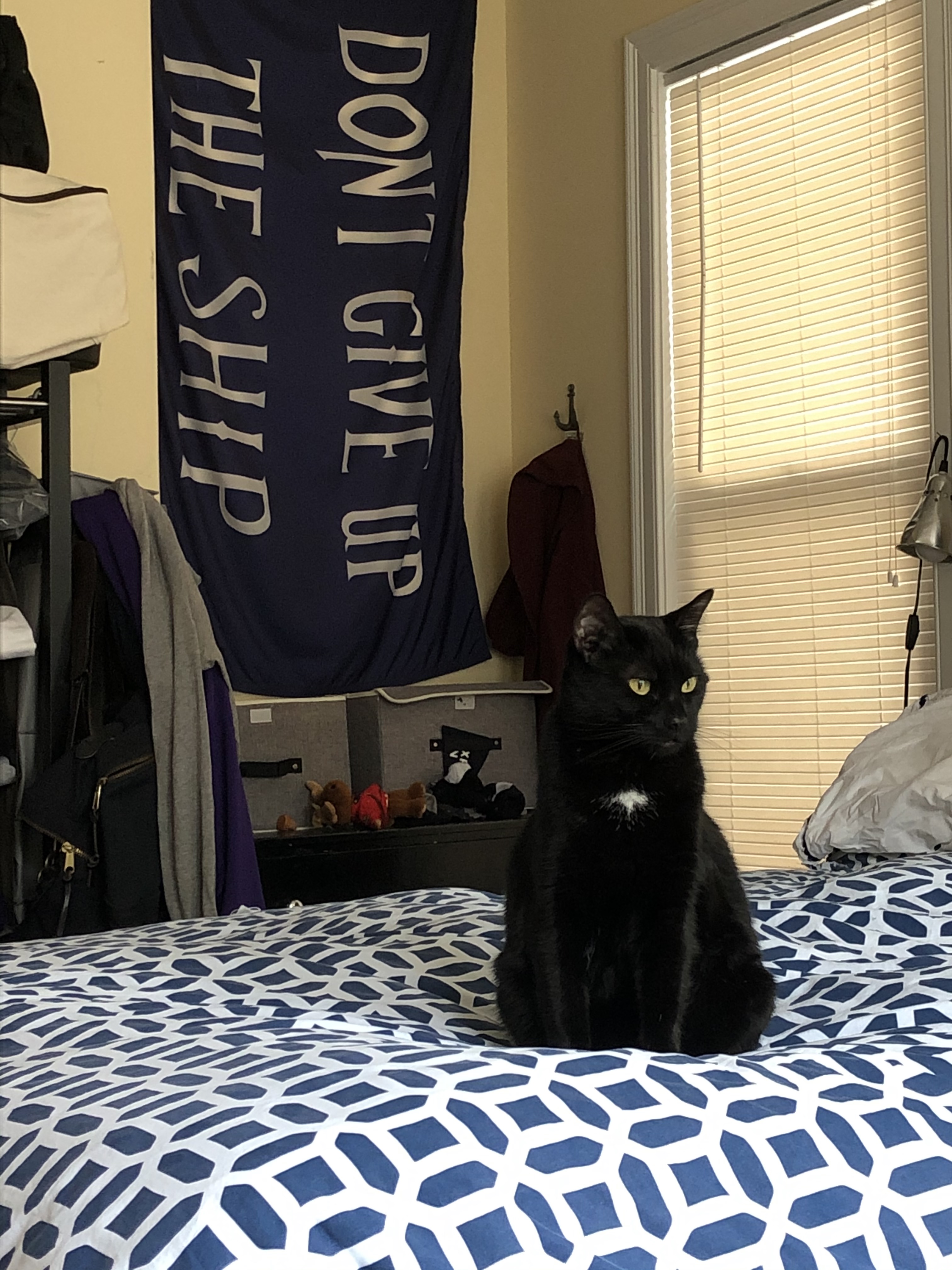
AJ and I went to a local no-kill animal shelter with a great reputation a few weeks ago, but the cats looked sad and ill and it didn’t feel very friendly to us. We waited a few weeks and the weekend before Easter went to an adoption event at a pet store run by another animal rescue not-for profit. This organization specializes in cat rescue and doesn’t have a shelter. All their animals are fostered. AJ and I both fell in love with a black and white kitten at first but she needed to be adopted into a home that already had a cat, which wasn’t us. Then AJ spotted a tiny black cat, full grown but kittenish, all black with a tiny white spot on her chest. Her name was Jaguar. Jaguar charmed AJ immediately and we put in an application. Just under a week later, she moved in and now we wonder how we survived without her. She’s approximately 70% cuddles and 30% ninja, which is about right. When I come home from work, she meets me at the door and when I sack out on my bed in the evening, She jumps up and sits on me purring. Somewhere in between, she generally likes to hide behind our bedskirt and leap out at passing feet. Also, she is a champion napper. She was purring up a storm when I took this photo.

We are glad she’s here. And I think she’s glad too.
* * * * *
I’ve taken a few days off this week to get my head together after a pretty grueling few months at work. Mr. Spy is away for a few days with his baseball team. AJ is on spring break and is getting himself to and from baseball games and working at a baseball break-week camp in the park. I am spring cleaning.
The weather is perfect today, so I started on the front porch, watering the plants, washing the windows, attempting to mend the table that inexplicably has shed several screws over the winter. I was in the middle of the latter task when I heard someone say hello. I looked up and saw a small woman, maybe about my mother’s age standing on my steps. “I’m Estelle.”
* * * * *
Our first spring in the house, Mr. Spy texted me one Friday while I was kayaking in the park. “Estelle stopped by. She likes your flowers.”
“Who’s Estelle?”
“She knew someone who used to live in our apartment and they had flowers too.”
I had just filled the windowboxes attached to our front porch rail with herbs and purple petunias. She was happy to see them.
The whole thing had made me smile. I was sorry not to have been home. Stopping by to admire the flowers seemed like something Mr. Spy’s mother would have done, and she was rich in neighbors and friends.
* * * * *
One of the traditions where I went to college was Friday afternoon tea. We would all pile down into the living room of our dorm and drink tea and eat cookies and catch up with each other on our week. It was a relic from long ago and we all loved it. On VisageTome, there is an alum group devoted to Friday tea. Every Friday, people from all over post their college dorm and year, what “tea” they are drinking, the best thing that happened this week, and the worst, and a photo of the tea (or sometimes of something else). It is an amazingly lovely space, a moving history of women’s experiences in the world, the remarkable and the mundane. We are learning each other’s stories. One day last year I was working at the table I was trying to fix today on my front porch. I took a picture of the cup of coffee on my porch looking down the street. Someone commented on my photo. “I know this sounds crazy, but I think my aunt used to live in your apartment.”
She wasn’t crazy. Her aunt did live in our apartment. Her aunt was Estelle’s sister. Estelle is her mother. And she herself lives a few blocks from me.
* * * * *
“I’m so glad to meet you!” I said to Estelle. “I’ve heard so much about you. Would you like to come in?”
Estelle was amazed to see the place. It had been carpeted before and she didn’t know about the intricately patterned wood floors. Her sister’s husband was an editor. “Like me,” I said. Our dining room had been his office. “It’s good there are still a lot of books here.” Her sister had been a weaver and our bedroom was the loom room. “There were floor to ceiling shelves full of beautiful wools there,” she aid, gesturing toward the wall behind the headboard of our bed. She told me how after her sister had died, she’d had to figure out how to dispose of all of her weavings. “I heard about a place in Massachusetts where they were asking for volunteers to make shawls for the residents.” She sent them 40 shawls. “I like thinking about them having another life.” In the kitchen she told us that the refrigerator had been in the closet that now houses our washer and dryer and how when her sister’s husband was ill and in the hospital she came over to check on things and discovered the freezer was a solid block of ice.
“I came over to take care the cat. She was called Pearl because she was a little black cat with a tiny white spot right here,” and she pointed to her heart.” Just then Jaguar walked in.

“Just like our cat.”
“Wow, that’s spooky. She looks just like Pearl.”
* * * * *
Like most cats, Jaguar is a little spooky. She has been with us for less than a week and she already seems to know who needs her the most at any given moment. I wouldn’t be at all surprised if one of her nine lives was as Pearl the cat who used to live here. She’s our benevolent household spirit, currently snoozing in the armchair in the corner. I wonder what she is dreaming about.
Lookout
One of the things I love about my apartment is the windows. Our last apartment had a row of windows over the street in the front room and a skylight that brought in light from above. AJ’s bedroom looked down the narrow walkway between our building and the one next door and he could see the top of a tree in the yard behind and a sliver of sky, a real Brooklyn view. Our bedroom looked into a dim airshaft, darkened further by the mesh covering to keep the pigeons out and the air conditioner that blocked most of the window. Our current apartment is a full floor of a freestanding house, so we have windows all the way around. 17 of them. It seemed important to count when we moved in. Windows are a luxury. I did laps around the house, looking out each one.
The kitchen has two windows—well, three if you count the tiny one in the laundry closet. They overlook the backyard of our net door neighbor, Louise. Louise grew up in the neighborhood and has lived in her house since she was 10 (she is now, I’d guess, somewhere around 80). Louise’s backyard is mostly cement. Her driveway runs between our buildings into a garage. There is an unused brick grill, some cement statues of children carrying umbrellas, a few white plastic chairs, and clotheslines. She hangs out her laundry a couple of times a week and also the plastic bags that she washes and saves. A large fig tree grows along the chain link fence on the far side of her yard. In the summer, just visible around the edge of her garage, roses grow against its far wall.
Beyond Louise’s yard is a view to the apartment buildings one street over. I occasionally see people smoking on their balconies or shaking out their rugs or having a cold beer on a hot day. At this time of year, there are cheerful lights on the balconies. Between the buildings and the trees on the street I can see a patch of sky. Out the rest of the windows in the house, I see trees and birds and people walking dogs, but I love the view out the kitchen with its layers and abstract angles. I find myself looking out those windows a lot.
Last night as I was puttering around the kitchen and listening to a podcast, I looked up to see the room bathed in a pink-gold light that made even the white plastic chairs look elegant. It didn’t last long and felt like such a privilege to see it. I walked to the next room to get Mr. Spy but by the time we came back it had already changed.


 spynotes